
For wireless contractors deploying crews to remote tower, small cell and venue sites, field labor can represent more than 70 percent of operating costs.
This includes tower crews, small cell and DAS installers, carrier upgrade teams and venue installation companies.
Even though field crews represent most of their costs, wireless contractors often have limited visibility into where these labor hours are spent.
The standard tools of the trade – whiteboards, spreadsheets, and manual time entry with paper timesheets or most available timekeeping apps – aren't sufficient to answer important questions about where your labor costs are going:
- How much time are employees spending at the job site?
- Are these labor hours being allocated to correct job codes?
- Where are the opportunities to reduce non-productive hours, specifically time spent away from the job site?
A recent Fieldclix study found that field crews can spend up to 30 to 40 percent of their time away from the job site. This includes drive time between sites, supplier visits, unplanned stops, and excess time at the office or warehouse.
For a wireless contractor with 20 field employees, this can represent more than 14,000 hours a year spent away from the job site. A 15 percent reduction in this non-productive time (or 2,100 hours) is the equivalent of gaining an additional field employee.
Fieldclix clients are achieving even greater productivity levels, which we will cover in the following case study.
Calculate your labor cost savings →
The customer
A Significant Opportunity
Kent Smith, COO of Wireless Services, a wireless venue installation company in Gonzales, Louisiana has spent more years than he would care to admit working in the field. However, his deep experience brings insights into all the ways labor hours can “leak out of the bucket.”
These days, Kent's focus is overseeing the daily deployments of more than twenty dedicated field crews across six states. “These types of projects require tight coordination with remote teams, material suppliers, clients, and multiple third parties,” Kent explained, “and more often than not, the accounting of field hours gets lost in the mix.”

“With Fieldclix, our Operations Managers can keep a close eye on labor hours and hold their field teams accountable to hitting concrete targets.”
Facing a growing workload and challenges in hiring qualified field resources, Kent decided it was time to find a way to get improved visibility into his field activities. “We had too many people giving an estimate of their hours at the end of the week, with no ability to determine how many hours were spent on different activities,” Kent said. “Because of this, our Project Managers and Operations Managers had limited situational awareness of how labor hours contributed to progress on their remote builds.”
After evaluating several software options, Kent selected the Fieldclix platform, which uniquely captures remote timecard data with GPS tracking and geofences. “We looked at many mobile timekeeping applications such as T-Sheets, but they still required field crews to manually indicate when they arrived on-site and select the proper job codes, which inevitably introduces human error into the system.” He added, “Fieldclix automatically tracks when employees arrive and leave the job site, so all they have to do is clock-in and Fieldclix takes care of the rest.”
The solution
Increase Remote Team Time On-Site
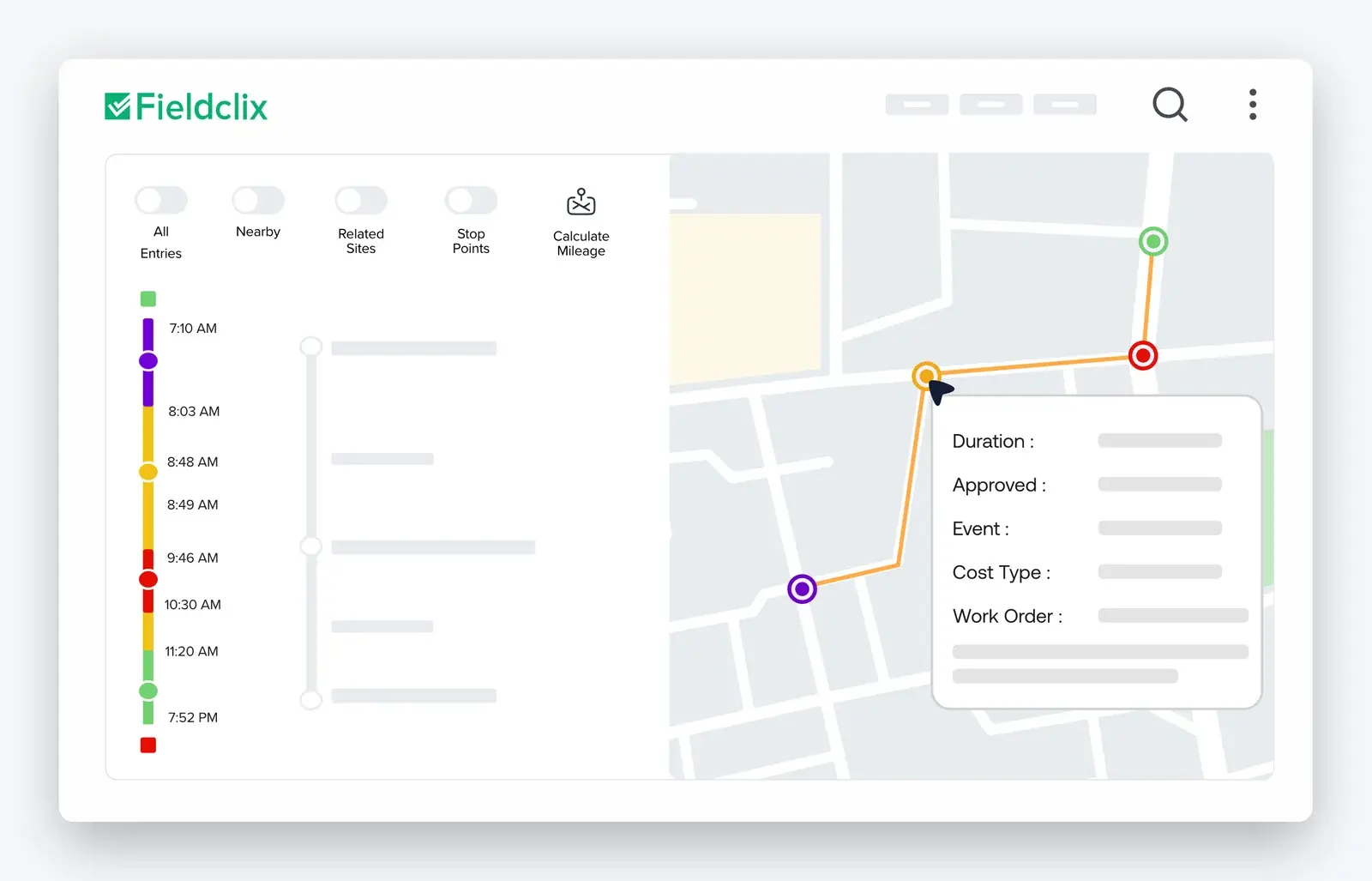
With automatically generated timecards based on GPS, Kent and his project managers get accurate daily updates on where field hours are being spent. They now have the ability to work with their field crews to identify and eliminate unnecessary off-site activities.
As an added bonus, Fieldclix automatically allocates labor hours to the correct job code, so Kent's project managers get early warnings on potential labor cost overruns, which allows them to make adjustments while there's still time to make a difference.
Before Fieldclix
- Crews estimated their hours at the end of the week
- Job codes picked by hand, with human error
- Little visibility into how hours drove progress on remote builds
- Committee-based estimating
With Fieldclix
- GPS timecards generated automatically every day
- Hours allocated to the correct job code
- Early warnings on labor cost overruns
- Data-driven pricing on bids
The results
Even More Benefits
With these newly deployed timekeeping processes in place, Kent and his team experienced immediate productivity improvements with their mobile workforce. “At the end of the day, we were able to get more work done with our existing team.”
In addition to the productivity improvements, Kent saw some positive trends across the company.